Content Warning: Suicide and Depression
The following content contains discussion of suicide and depression. If you find these topics distressing, you may choose to skip this blog post, or return when you feel ready. Please always take care of yourself .
So there’s this very popular excerpt from Sylvia Plath’s novel, The Bell Jar, and it goes a little something like this :
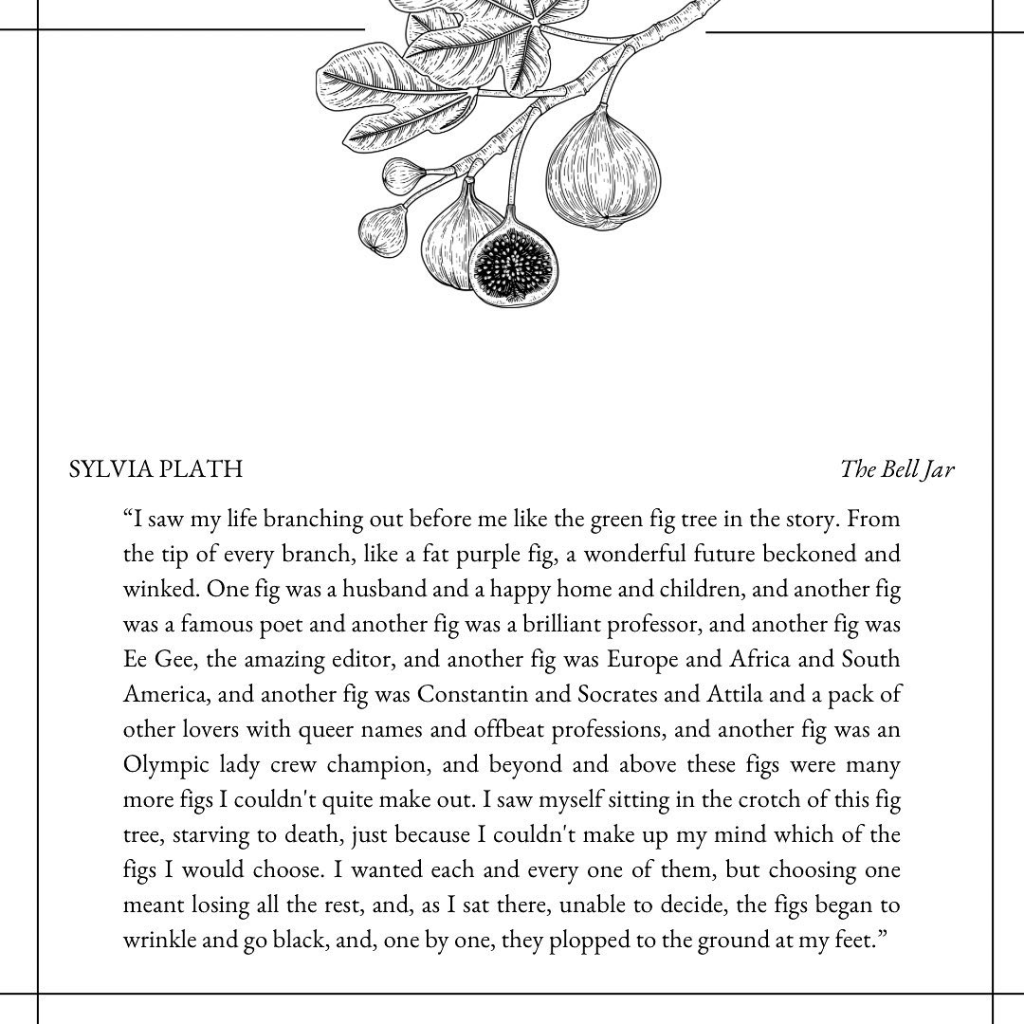
As you can imagine, this metaphor evokes so many emotions on its initial read. You probably grasp or even identify with what the author is talking about – someone seeing their life as a metaphorical fig tree, with the fruit being the decisions we have, in our various pathways ( branches) .The longer you take to decide on what fig to pick, it will eventually dry up ( the opportunity may/ will no longer be there anymore.) Essentially, we need to make a choice in life of what we want, and actively choose it.
Now, I am not going to lie to you, I hadn’t heard of this fig tree analogy until Mike introduced me to it a few years ago. I also have never read The Bell Jar, so I only understood this passage, isolated, and not in its entire true context.
Remember my post from last week on contextomy? This was actually the inspiration behind it. I felt so connected to what I initially believed was the meaning behind this fig tree metaphor, so I wanted to make it a mission to understand why this was written and then see if I still felt the same way.
& well …let’s talk about it.
As I researched The Bell Jar, I stumbled upon a summary written by David Griffin Brown for a blog called The Darling Axe that gives us a generic gist :
“ Esther Greenwood, a talented young poet and college student, lands a prestigious internship at a fashion magazine in New York, but her excitement quickly turns to disillusionment as she grapples with the pressures of work, her relationships, a complicated dynamic with her boyfriend Buddy Willard, and societal expectations for women to marry and have children. Her descent into a mental health crisis culminates in a suicide attempt and subsequent admission to a psychiatric facility. In the institution, Esther undergoes electroconvulsive therapy and faces the daunting prospect of integrating her experiences into a semblance of normalcy as she tentatively steps toward recovery.”
The metaphor of the fig tree was written in chapter 7, right at the beginning of her breakdown of choices.
What I then understood was that this metaphor was written to perpetuate the feelings Esther had of true hopelessness and despair. The choice paralysis and societal pressures she endured, was written not from a healthy perspective of choice and “striking while the iron’s hot”, but from a place of turmoil and struggle.
On one hand, yes, the metaphor in itself should be appreciated for its candidness and truthfulness. Because the reality is, and I have said this before and I will always scream this from the mountain tops :
If you do not choose what to care about, life will choose for you.
It is factual that in life we do have choices, and we need to be proactive in making them
However, we also need to understand that this metaphor is not a reflection of a universal truth of choice. Here are some of my perspectives –
- The metaphor does not take into consideration opportunity and privilege – we all do not have the same figs on our trees.
- Choosing, or not choosing a fig, does not mean the opportunity has disappeared forever- it may just change. Sure, if you choose to move to the other side of the world, figs would be different there than what would be in your hometown. This is a given though, so you have to then figure out what is important to you.
- You can be a good husband, a good father and a good businessman, all at the same time. Multiple figs can be chosen at once. There is no rule. It is what works for YOUR life.
- Life does not work in polar opposites – it is not just black and white. There is a grey. There is a middle ground that we can exist in, where we can maybe take a bite out of one fruit and head in a totally different direction. You don’t have to sacrifice love for work or vice versa. Again it is what works for YOUR life.
- The fig that you choose does not define who you are as a person. You are not JUST a lawyer and you are not just a mother.
- Many of us can figure out the figs we want to choose as we go, without pressure.
Does this change how you perceive this metaphor now?
Remember that we all live in a state of constant comparison. Our age, our gender, our race, our salary, our relationship status…everything can and usually is subjected to a form of “selective understanding” as i’d like to call it – where people look at one part of our identity and use it to make an assumption about who we are or what we are doing. Even if we choose to NOT do something, an assumption is made about that too.
This is something we cannot control ( thanks to good ol’ social media)
What we can control is how we look at our own lives, our own opportunities, and our own figs. We all have our own trees that bear fruit at different paces. We are responsible for how the tree grows, and what fruit dries up. Pour into yourself, love yourself, and take care of your tree – that is when the opportunities ( figs) will present themselves.


 The Graceful Human
Leave a Reply